
Fleet data is most valuable when it is complete, available, and tied to the work that actually happened. That can be difficult when vehicles and heavy equipment operate across rural roads, remote project sites, maintenance yards, and other areas where cellular coverage is limited, inconsistent, or too costly to provide for every asset.
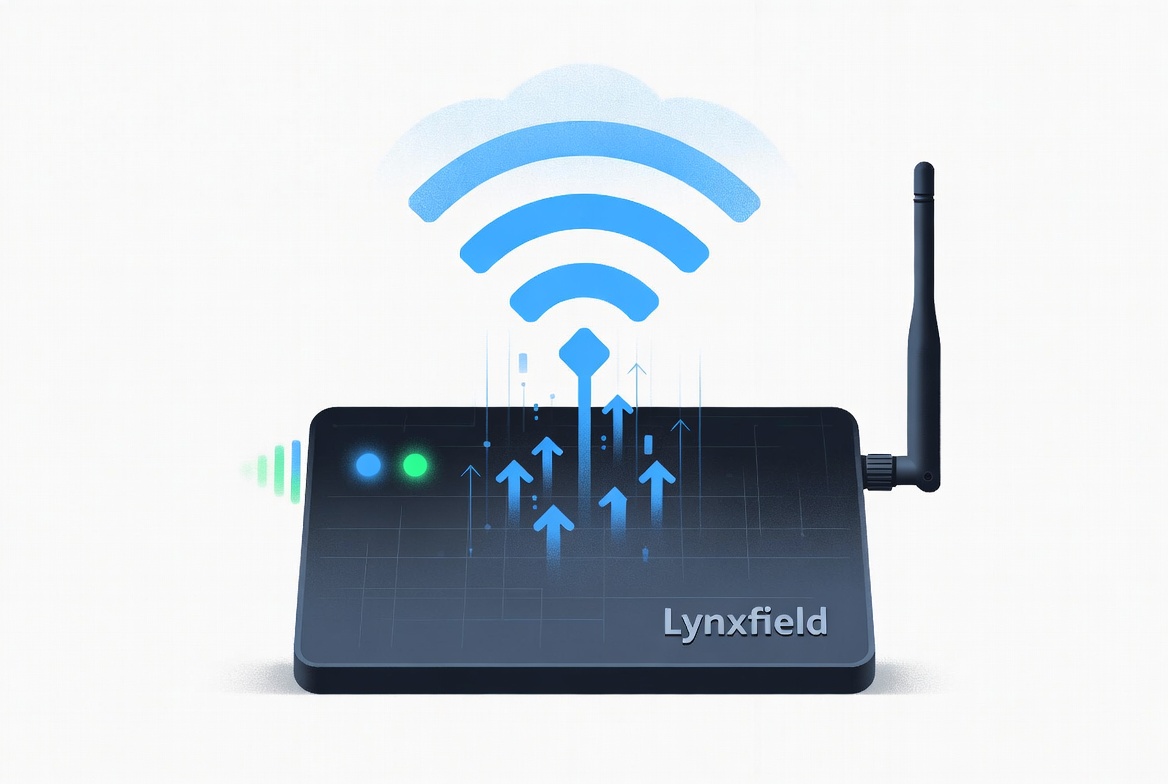
The Lynxfield LX4 addresses that challenge with a flexible connectivity approach. In addition to cellular communication and offline data storage, the LX4 includes embedded Wi‑Fi capability. When a vehicle or machine comes within range of an approved Wi‑Fi network, stored AVL/GPS and operational data can be uploaded without waiting for cellular service.
The result is a more resilient path from field activity to the records supervisors, managers, and clients rely on.
Connectivity should match the operation
Continuous cellular connectivity is useful, but it is not always practical. A road-maintenance vehicle may spend part of its shift outside coverage. A contractor may operate equipment on a closed project site with local Wi‑Fi but no cellular service. A large fleet may need dependable utilization and location records without adding a recurring cellular plan to every machine.
LX4 connectivity can be configured around those realities:
- Cellular connectivity can transmit information while coverage is available.
- Offline storage preserves records when no network is available.
- Embedded Wi‑Fi provides another upload path when the unit reaches an authorized network.
These are not competing modes. Together, they help maintain continuity as equipment moves between connected and disconnected environments.
Store in the field, synchronize in Wi‑Fi range
During a route, circuit, or work assignment, the LX4 can continue collecting supported location and operational records even when a live connection is unavailable. The data remains stored until a configured transmission path becomes available.
When the vehicle returns to a yard, depot, garage, transfer point, or project area with approved Wi‑Fi, the unit can synchronize the collected information. That may include the route travelled, completed circuits, GPS history, and other supported records captured during the operation.
For field teams, the process reduces dependence on manual uploads and handwritten reconstruction. For supervisors, it provides a clearer operational history after the equipment returns to network range.
Stronger road-maintenance reporting
Road-maintenance organizations are often expected to demonstrate when and where work was performed. Route completion, winter-maintenance activity, patrol coverage, and scheduled service records may all contribute to internal review, client reporting, compliance documentation, and liability monitoring.
A missing network connection should not create a missing operational record.
By combining offline capture with cellular and Wi‑Fi transmission options, the LX4 helps organizations preserve a more complete account of field activity. Once synchronized, the information can support questions such as:
- Was the assigned route or circuit completed?
- When did the vehicle reach a particular road segment or service area?
- Where did gaps, delays, or exceptions occur?
- Is the collected history available for operational review or client reporting?
- Can supervisors verify activity without relying only on paper logs or operator recollection?
The value is not simply knowing where a vehicle is at one moment. It is retaining a dependable history of the work performed.
A practical option for projects without cellular service
Some operations take place where cellular connectivity is not available at all. Remote construction projects, forestry operations, aggregate sites, mines, large private properties, and temporary work zones may still need equipment tracking and completed-route records.
In these environments, Wi‑Fi synchronization can provide a practical alternative. Equipment can collect supported data throughout the shift and upload it when it enters range of the project’s network. The Wi‑Fi connection might be available at a maintenance building, site office, fuel point, gate, or other controlled location.
This makes it possible to build an operational record without requiring continuous cellular access across the entire project area.
Reduce cellular dependence across large equipment fleets
For large-equipment owners, the cost of connectivity can grow quickly. Providing a dedicated cellular plan for every loader, grader, excavator, sweeper, trailer, or specialty machine may not make economic sense—particularly when some assets only need periodic reporting.
The LX4’s embedded Wi‑Fi capability creates another deployment model. Organizations can collect the information they need and synchronize it through their own authorized networks, reducing dependence on always-on cellular service for suitable applications.
This can be especially useful for:
- municipal and contracted road-maintenance fleets;
- construction and earthmoving equipment;
- forestry and resource operations;
- airport, port, campus, and industrial-site vehicles;
- seasonal equipment;
- machines that return regularly to a connected yard; and
- assets operating in locations where cellular coverage is unavailable.
The right configuration depends on how quickly the organization needs the data, where equipment travels, and what networks are available. A mixed fleet may use cellular communication for time-sensitive vehicles and Wi‑Fi synchronization for assets that only require periodic uploads.
Build a reliable path from equipment to reporting
Reliable fleet reporting begins with a simple principle: collect the data when the work happens, preserve it when the network disappears, and transmit it through an authorized connection when one becomes available.
The Lynxfield LX4 brings cellular connectivity, offline storage, and embedded Wi‑Fi together in one device. That flexibility helps road-maintenance and heavy-equipment organizations improve data completeness, support operational and compliance reporting, and extend tracking to projects where cellular cost or coverage would otherwise be a barrier.
Wi‑Fi availability, synchronization timing, security controls, and supported data depend on the network and deployment configuration. Lynxfield can help determine the right connectivity model for each fleet, site, and reporting requirement.
Plan the right LX4 connectivity model
Whether your operation needs live cellular visibility, offline resilience, yard-based Wi‑Fi uploads, or a combination of all three, Lynxfield can design an approach around your equipment and reporting needs.
Contact Lynxfield to discuss an LX4 connectivity plan for your fleet or remote project.